Average Reviews:

(More customer reviews)The HVR-Z1U seems too good to be true. And it is.
It promises a camera with full HD resolution and outstanding features for a reasonable price. In many ways, it delivers. The video quality is superior to the JVC HDV camera. Unlike the JVC, the camera offers full manual control and is a pleasure to shoot with professionally.
Alas - for someone who expects and needs full HD resolution, the Sony is a disappointment. Pointing the camera at a resolution chart while viewing the output on a high resolution monitor (or on a computer after rendering to 1080i or 1080p) quickly reveals that the horizontal resolution is about 1200 lines, and vertical resolution is a little over 500.
The pixel count is thus about twice that of standard video, not four times, as we perhaps hoped. The 1200 lines of horizontal resolution is pretty good - just about the same as 720p. But the vertical resolution is not very good at all.A little math tells the story. Sony advertizes 1.1M pixels for each sensor, and 1440 lines horizontal. 1.1M/1440 gives a maximum of 770 lines vertical, not 1080 as promised. The measured vertical and horizontal resolution is distinctly lower.
An extensive web search revealed that the sensor has 1080 vertical lines, but only about 990 lines horizontal. To achive something closer to 1440 lines horizontal the green sensor is offset by half a pixel, and image processing is used to give a possible maximum resolution of 1440 on a black and white image. The problem is that the edge contrast beyond 900 lines horizontal becomes quite poor.
To make matters worse, (or to degrade the vertical resolution to match the horizontal) the vertical lines are read out of the sensor in pairs, so that each field is a mixture of two adjacent lines. This gives the vertical the same poor edge contrast as the horizontal.
It is possible by using the unsharp mask tool in Sony Vegas (or other editors) to improve the edge contrast. I use the maximum effect with the minimum radius in the Sony tool - setting the radius slider to .001 pixels. You must do the sharpening operation using a properties setting of 1440x1080. Slightly better results can be obtained by putting an additional unsharp mask in series with the first, set to half-effect.
A major problem is deinterlace. Most editors (and most display devices) deinterlace by averaging fields, which reduces the maximum vertical resolution to 540 lines. You can add Mike Crash's excellent deinterlacer to the sharpening masks, and remove this limitation. Crash's smart deinterlace for Vegas can be downloaded for free - with patience and persistence.
Sharpening and deinterlacing the image is very compute intensive. It takes me a good fraction of a week to do a two hour movie on a 3GHz pentium 4. But the result can be stunning. With the sharpening the Sony camera can give you a result that is close to a professional HD camera. I render to WMV9 rather than to MPEG2 - remember to keep the properties at 1440x1080. After the render is complete, you can re-render to 720p, adding an additional bit of sharpening to compensate for the re-interpolation.
For best results always use a shutter speed of 60 frames/sec or higher. I have had mixed results with the steady shot option. Keep the camera as steady as possible, and try not to use more video gain than absolutely necessary.
Bottom line - this camera produces video that is MUCH better than standard video, and significantly better than DV. But it would be awfully nice to have a camera that delivered the advertized resolution, and did it with a flat video frequency response.
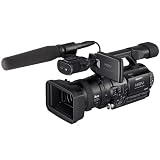
Click Here to see more reviews about: Sony Professional HVR-Z1U 3CCD High Definition Camcorder with 12x Optical Zoom
With high-definition television sets replacing standard definition, it's time for a high quality HD camera to lead prosumer video into the future. Sony's HVR-Z1U Digital HD video camera recorder is just such a camera. It's the compact and cost-effective machine that bridges the gap between high definition and standard definition video formats.
HDV 1080i The HDV 1080i specification features 1080 effective interlaced scanning lines and 1,440 horizontal pixels. Interlaced pictures, which have been common to TV broadcasts from the beginning, alternately display odd and even numbered lines between each screen refresh. The HVR-Z1U can also record at the HDV 720p specification, which features 720 effective progressive scanning lines and 1,280 horizontal pixels. Progressive scanning fills both odd and even numbered lines with each refresh, providing a flicker-free picture.
Not yet ready for HD? The HVR-Z1U can convert material from 1080i down to 480i and 576i, and output these digital video signals through its i.LINK interface or as analog signals through component, composite, or S-video connectors. When down-converting these signals, the aspect ratio displayed can be converted from 16:9 to 4:3, and display modes can be selected from squeeze, letterbox or edge crop.
Audio The HVR-Z1U adopts the MPEG-2 compression format, which uses 8-bit digital component recording with a sampling rate of 4:2:0. The camera uses MPEG-1 Audio Layer II audio compression format, allowing for two-channel recording with a sampling frequency of 48 kHz/16-bit. It features a built-in stereo microphone, as well as two XLR audio input connectors for use with professional-grade microphones or external audio sources. Each input level for CH1 and CH2 can be independently adjusted using two audio level dials on the camera body and viewed with an audio level meter on the LCD monitor.
3CCD camera system Originally, camcorders used one CCD--the imaging device that turns light into electronic information--and let the image processing unit decipher the color information from the data. Like today's broadcast video cameras, however, the HVR-Z1U uses a prism to divide incoming light into three beams and uses specially tuned 1/3-inch CCDs to create red, blue, and green composite images, which are assembled into a final image. The result is a more film-like vibrancy and more accurate color representation.
Carl Zeiss Vario-Sonnar T* 12x zoom lens The HVR-Z1U is equipped with a Carl Zeiss Vario-Sonnar T* high definition lens with a 12x zoom function. It has the same optical coating as is used on all of the Carl Zeiss prime lenses, which produces sharp, high-contrast images with virtually no chromatic aberration. This lens is designed with a wide viewing angle, and a 35-mm equivalent focal length ranging from 32.5 mm to 390 mm in 16:9 mode, and from 40 mm to 480 mm in 4:3 mode.
In order to facilitate zoom control and recording operation during low-angle shooting, an additional zoom lever and a rec start/stop button have been added to the carrying handle. There's also a motorized zoom ring, equipped with stops and barrel marking, located on the lens body. Turning this zoom ring allows for fine adjustments in zoom position settings. Furthermore, the supplied wireless Remote Commander unit can be used for external control.
Large, 16:9 widescreen color viewfinder and LCD monitor View your subject through the built-in viewfinder, the swing-out LCD display, or both. The HVR-Z1U features a 0.44-inch type color LCD viewfinder and a 3.5-inch color LCD monitor, both in a 16:9 aspect ratio. You'll save battery time by using just one, but you may want to use one for adjusting focus and the other for monitoring audio levels. When eschewing auto focus for the fine-tuning manual focus, you can double the magnification at the center of the screen, making it easier to confirm focus settings during manual focusing. Also, the camera's "peaking" function can provide sharp outlines on the monitor to help with manual focus.
Optical Super SteadyShot system Sony's optical Super SteadyShot System helps remove the slight hand jitter and vibration that is often the bane of video production. Sensors inside the camera detect horizontal and vertical movements and the camera can counteract those movements by adjusting the lens mechanism on the fly. This is superior to digital anti-shake systems that counteract image shake by trimming off edges of the frame.
The Hollywood look The HVR-Z1U has features that can make your videos look more like they were shot on film. Cinematone Gamma allows operators to quickly setup and load a gamma curve with similar contrast characteristics to a film gamma curve. The Cineframe feature allows movement to be reproduced at 24 frames per second--the speed of film--as opposed to video's 30 frames per second standard. The Color Extraction function can retain up to two desired colors of monitored pictures in the screen by designating color hue, saturation and range, while making the other colors black and white. The Color Revision function can change the hue of only the colors designated by Color Extraction, while retaining the hue of the other colors, thus making it possible to change the color of something you've already shot.
No new tape stock The HVR-Z1U is compatible with conventional DV tape stock, but Sony recommends the use of DigitalMaster PHDVM-63DM tape, with its dual layer of magnetic material, which delivers higher RF output, lower noise, 95% fewer errors and 60% fewer dropouts compared to regular DV tape.
More camera features
What's in the box HVR-Z1U, AC-VQ850 AC adaptor/charger, power cord, connecting cord, lens hood, large eyecup, RMT-841 wireless Remote Commander unit, A/V connecting cable, component video cable, shoe adaptor, NP-F570 InfoLithium rechargeable battery pack, two AA-size (R6) batteries, cleaning cassette, shoulder strap, and operating instructions.


0 comments:
Post a Comment