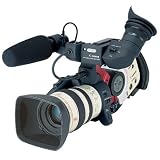
Average Reviews:

(More customer reviews)I have used this camera at a few weddings, along with a Canon GL1, and I personally own a Canon Optura. I have also used a Sony TRV1000, and TRV20.
First off, let me mention that progressive scan is absolutely incredible. I can no longer stand the home-userish look of interlaced video. What progressive scan (or "frame mode") does is it takes 30 full frames per second. Interlaced records 60 FIELDS per second, creating a supposed 30 fps (giving it that unrealistic, slimy-smooth motion like a home Hi8 camera). What FULL frames do is make it have a somewhat "jerkier" effect which gives the footage a much more film like look. It's beautiful, you've got to see the difference side by side, sometime (or just switch between interlaced and frame on the XL1, or some other Canon).
The Color: There are many sites with side by side comparisons of the XL1 and the VX1000 (perhaps the VX2000, too). The thing is, there is no comparison. Sony's lenses lean toward the blues, giving it a very cold, unnatural feeling (not to mention interlaced un-naturalness!). The blueness is so apparent, that at times you must add color corrections, wasting time in post. Canon leans towards the reds, giving it a much warmer, more realistic coloring, and shading. But, what do you expect? Canon has been in the business of lens making for a long time. Who ever heard of Sony making a 35MM cinematic lens? Yes, some Sony cameras have Carl Ziess lenses, but they still have the blue tint to it. In fact, those are the lenses I was speaking of earlier as being cold, and blue.
Optical Stabilization: The stabilization is incredible to see when zoomed all the way! There is virtually no visible shake, whatsoever. Of course, this does not replace the rock solidness of a tripod shot... but for handheld work outdoors, it is indispensable. Some people have mentioned that when shooting a tripod shot across a canyon or some such thing, that it tends to "stick." All you have to do when shooting tripod shots is simply turn off the image stabilization.
All that, and the ability to control the shutter speed, the aperture, the exposure, the focus, the ability to change lenses... even to 35MM Canon EOS lenses (with an adapter)! All these things and much, much more make this the camera to own. I would take it over a $15,000 interlaced beta cam any day (unless I could sell that camera, and buy a few XL1s!;).
This camera is highly recommended be me. Canon even made a commercial with it ... for their ZR10! Buy today, you won't regret it (and no, I don't work for Canon:). If you're just considering buying a MiniDV camera, but can't afford this one, still, go Canon. Most of them have a lot of the of the same features (GL1, and Optura), or slightly dumbed down HIGH quality home cameras that still have progressive scan (Optura Pi, Elura, Elura 2).
Click Here to see more reviews about: Canon XL1 Digital Camcorder Kit
The Canon XL1 is helping to blur the line between consumer and professional video equipment. Though it's small enough to carry around and doesn't cost much more than a top-of-the-line consumer camcorder, the XL1 produces such high-quality results that many independent filmmakers have started using it instead of a traditional film camera.
Great movies start with great CCD sensors, and Canon cuts no corners here. For the best possible picture quality, they use three separate 270,000 pixel CCDs (one for each primary color). To further improve image detail, Canon has intentionally shifted the green CCD half a pixel horizontally and vertically. This shift allows more accurate interpolation, resulting in an image that Canon claims rivals those from cameras with 410,000 pixel CCDs. Each pixel is 72 square microns, which is about 1.5 times the size as those in competing camcorders. This increased size increases light sensitivity, allowing you to shoot in lower-light situations. Ultimately, the larger pixel size results in an improvement of 4 dB in sensitivity.
The XL1's body is based on a magnesium-alloy frame for maximum durability. It ships with a 16x optical zoom lens with optical image stabilization, but is also compatible with other XL camcorder lenses. With an optional adapter, you can use Canon EF (EOS) still camera lenses--some of which also feature optical image stabilization.
Though the camera's built-in microphone has a great frequency response, the XL1 can also accept balanced microphones with the optional MA-100 microphone adapter/shoulder pad. The XL1 records digital audio, with two channels of 16 bit/48 KHz sound or 4 channels of 12 bit/32 KHz sound.
The electronics of the XL1 have many advanced features, including a number of programmed AE modes, as well as both shutter and aperture priority modes. There are two different auto modes, one of which allows you to adjust any setting manually, if you want, and the other, which adjusts every setting automatically and lets you adjust nothing. A spotlight mode automatically compensates for difficulties when shooting a subject bathed in a spotlight. There are also three different shooting modes: Normal Movie, Digital Photo, and Frame Movie. Normal Movie mode is for any time you want to shoot video footage. Digital photo mode records a still image for six seconds on the mini DV tape and also captures any audio, such as a commentary. The Frame Movie Mode records 30 noninterlaced still images per second, instead of capturing 60 fps interlaced images. This mode isn't intended to be used for shooting video (playback may not look completely smooth). Rather, Frame Movie mode should be used as a burst, or continuous, shooting mode, like you'd find on a still camera.
The XL1 uses an IEEE 1394 port for digital editing and for transferring footage to and from other IEEE 1394 compliant devices. The camcorder also has RCA (composite) audio and video ports, and an S-Video out. The XL1 features a LANC terminal for editing with compatible controllers.

Click here for more information about Canon XL1 Digital Camcorder Kit

0 comments:
Post a Comment